 The Spectator The independent student newspaper of Valdosta State University


By:Rut Labrada, Arts & Entertainment Editor
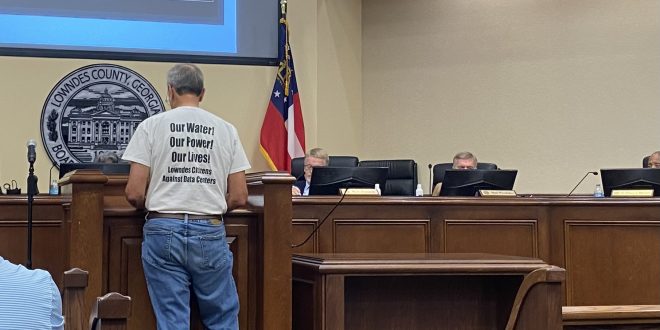
The Lowndes County Board of Commissioners listened to public input on an ordinance draft that placed restrictions on the building of artificial intelligence (AI) data centers at a regular meeting on Nov. 10.
On Nov. 2, the board first released the ordinance draft for public comment, following months of community concern from grassroots activist organization Lowndes Citizens Against Data Centers (LCAD) and other Lowndes residents after a plot of land near Foxborough was rezoned to industrial use in 2025 for a data center.
The 26-page document outlines all regulations that must be followed for the construction and operation of AI data centers within the county, including sound, environmental, building and water limitations. Notably, the draft required the data center to use a closed-loop water cooling system, capped the height of a data center at 40 feet, and restricted principal-use data centers to areas zoned for industrial use.
The board has previously stated that it will vote on the ordinance draft on Dec. 8, once edits have been made based on public comments.
Chairman Bill Slaughter explained at the meeting that, though commissioners would listen to the public’s vocal concerns, the board would only be considering submissions made directly to the Lowndes County Board of Commissioners website.
“We’re not going to really take anything that’s going to be in writing from anybody or anything from here; we’ve done that for the last several months,” he said. “We need to see good positive input. ‘No data center’ is not the answer to what we’re looking for. We’re looking for a good ordinance that we can generate that will be – as I’ve said all along – good for the citizens of this community, good for the community as a whole, but also is not going to slam the door on industry.”
During the Citizens Wishing to Be Heard section of the meeting, seven Lowndes residents voiced various concerns with the ordinance draft and what bringing a data center could mean for the City of Valdosta. Among these were issues with how certain sections were worded, as many residents felt that the draft could have been more specific.
LCAD member Tetiana Babcock pointed out that the sound section of the draft was vague, only specifying that any sound from the data center “shall not be audible to a person of normal hearing at the boundary of any sensitive-use district.”
Babcock requested the board to provide measurable appropriate decibel levels and test the sound emitted from the property over the course of several days for residential protection. She also voiced concerns with the repercussions that a data center would face for failing to meet these requirements.
“For a hyperscale facility that can represent billions in investments, a maximum of $1,000 per day fine is, quite honestly, disrespectfully low,” she said. “An operator can treat it as a minor cost of doing business, while neighbors absorb the sleep loss, the stress and the reduced quality of life.”
Michael Noll, LCAD organizer and former VSU professor, requested that the board organize a sit-down meeting with LCAD and concerned Lowndes residents. This would assuage many residents’ fears and allow them to be an active part of the ordinance-drafting process, he believed.
Dr. Noll also requested that the Lowndes County Board of Commissioners offer a second public comment period at their regular meeting in December. He acknowledged that, while this would delay the vote on the ordinance for another month, residents would like to look at a second draft of the ordinance and determine whether their suggestions were accepted.
George Fisher, a retired geologist and Lowndes resident, was another concerned speaker who attended the meeting. While he was also worried about the environmental effects of a data center, Fisher directed the conversation in an archaeological direction.
For Fisher, this land could be a landmine of natural history, and he requested that the board arrange a walk-through of the land so that he or others could study anything found there and contribute to Valdosta’s local history.
“I do think the land was a site of indigenous seasonal camps,” he told the Spectator. “A Muskogee Indian tribe lived here, probably from 600 CE up until they were wiped out and kicked out from Oklahoma. They were an amazing tribe, and they would come in here, I believe, and they would set up a seasonal camp.”
Currently, the Lowndes County Board of Commissioners is scheduled to vote on the ordinance draft on Dec. 8, but the Spectator will continue to provide updates as they come on this developing story.